Skip to content Skip to footer
About

Computer Science Engineering

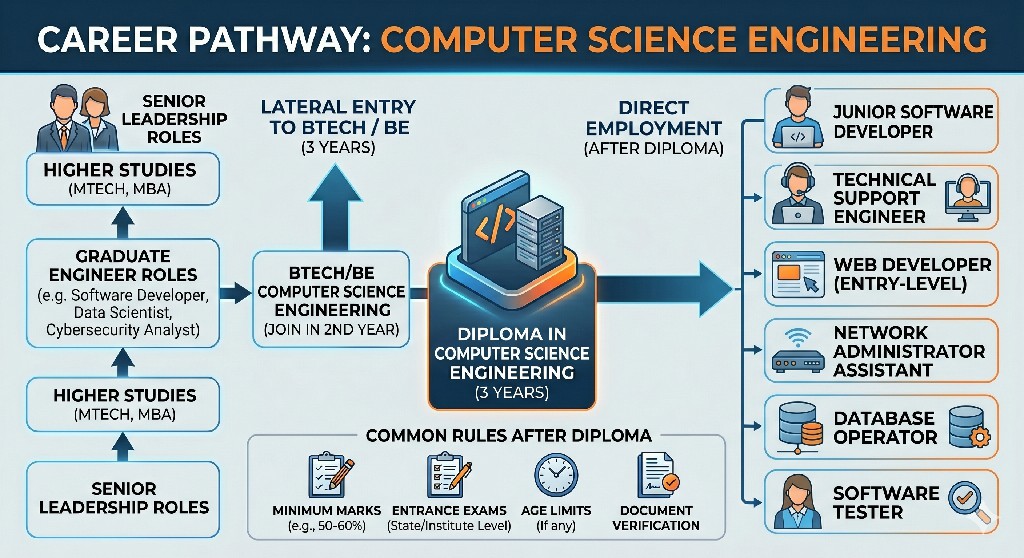
In the present world, most of the activities are being computerized with unprecedented level of technological breakthroughs and error free operations. This has resulted in an increased demand for skilled and competent professionals in the computer engineering sector. To cater to this, the Department of Computer Science & Engineering was established at SDM Polytechnic in 2008 with an intake of 60 students per year. The Department aims at training and educating the students on industry-related topics through regular curriculum as prescribed by the DTE and also with supplementary programs, throughout their study.

The Department of Computer Science & Engineering is one of the most popular and well-known departments at SDM Polytechnic. The Department has well qualified and motivated faculty members who are highly committed to the overall development of the students.

Along with the regular curriculum, the Department organizes various guest-lectures/invited talks by eminent faculty from reputed institutions/industry experts to keep students up-to-date about the latest technological developments. The Department has state-of-the-art laboratories equipped with high-end computers and other required peripherals to meet the academic needs of students. These computer labs are aimed at giving hands-on training to the students in the most advanced areas in programming and software development.

Vison

To establish as a center of excellence for education in the field of Computer Science & Engineering to transform students into competent professionals.

Mission

  •  To educate the students with best computational skills that ultimately bridges the industrial requirements.
  •  To provide a learning ambience to encourage leadership qualities, team-spirit and ethical responsibilities
  •   To encourage students to actively participate in lifelong learning and pursue higher education

POs

  1.  Basic and Discipline specific knowledge: Apply knowledge of basic mathematics, science and engineering fundamentals and engineering specialization to solve the engineering problems.
  2. Problem analysis: Identify and analyze well-defined engineering problems using codified standard methods.
  3. Design/ development of solutions: Design solutions for well-defined technical problems and assist with the design of systems components or processes to meet specified needs.
  4. Engineering Tools, Experimentation and Testing: Apply modern engineering tools and appropriate technique to conduct standard tests and measurements.
  5. Engineering practices for society, sustainability and environment: Apply appropriate technology in context of society, sustainability, environment and ethical practices.
  6. Project Management: Use engineering management principles individually, as a team member or a leader to manage projects and effectively communicate about well-defined engineering activities.
  7. Life-long learning: Ability to analyze individual needs and engage in updating in the context of technological changes.

PEOs

  1. Have successful careers in computer science and information technology field that meets the needs of society enriched with professional ethics.
  2. Take up higher education and adapt to the changing technologies, tools and societal requirements.
  3. Design and deploy software that meets the needs of individuals and the industries.

PSOs

  1. Understand, analyze and develop programming skills in the areas related to Data Structures, Python, Java, Web-Design, Multimedia, Operating System, Databases, Software Engineering, Computer Hardware and Networking for the efficient implementation of computer software and hardware.
  2. Apply problem-solving skills and the knowledge of computer science to solve real world problems.

“Computer science empowers students to create the world of tomorrow.”

LABORATORIES

Course Code: 25CS01I | Contact Hours: 7 Hrs/week | Credits: 5 | Teaching Dept: Computer Science(CS)

The launchpad course that turns a beginner into a digitally confident technologist — covering hardware,
the internet, cybersecurity, coding logic and today’s AI tools.


What Students Will Learn & Gain

  • Solid digital foundation — learn computer hardware, operating systems, networking basics and
    internet services — the vocabulary and know-how every IT/CS professional needs from day one.
  • Cyber-safety as a habit — hands-on practice with threat identification, strong passwords,
    multi-factor authentication, safe browsing and data backup builds a security-first mindset.
  • Problem-solving before syntax — block-based coding (Scratch/Blockly) and flowcharting develop
    algorithmic thinking, making later programming courses far easier to grasp.
  • Early exposure to modern tech — guided, hands-on activities in Cloud Computing
    (AWS/Azure/GCP), IoT (Arduino/Tinkercad) and Artificial Intelligence build familiarity with technologies
    shaping the industry.
  • AI fluency through prompt engineering — students learn to write clear, structured prompts and
    use tools like ChatGPT/Claude/Gemini effectively — a fast-emerging, highly valued workplace skill.
  • Career direction from day one — exposure to IT certification pathways helps students plan their
    specialization (networking, security, cloud, development) early in the diploma.

Course Code: 25EE01I | Contact Hours: 7 Hrs/week | Credits: 5 | Teaching Dept: Electrical & Electronics /Electronics & Communication
The essential bridge between hardware and software — giving computer engineers the electrical
grounding needed to understand the machines they program.

What Students Will Learn & Gain

  • Understands the physics behind computing — core concepts of electrical circuits, current,
    voltage and resistance explain how the hardware inside every computer actually works.
  • Foundation for digital electronics — knowledge of basic electronic components and circuits
    directly supports the parallel course on Digital Logic and Computer Organization.
  • Hardware and safety awareness — familiarity with electrical measuring instruments, safety
    practices and basic troubleshooting is valuable for anyone assembling or maintaining computer
    systems.
  • Supports IoT and embedded systems work — electronics fundamentals underpin later hands-on
    work with sensors, microcontrollers, and IoT devices seen in the IT Skills and other integrated courses.
  • Well-rounded engineering base — as a cross-department integrated course, it builds
    interdisciplinary awareness — a trait valued in engineers who design hardware-aware software.
  • Practical, lab-driven learning — the 3:0:4 teaching scheme (heavy on practice) ensures concepts
    are reinforced through actual circuit-building and measurement, not just theory.

Course Code: 25CS33I | Contact Hours: 7 Hrs/week | Credits: 5 | Teaching Dept: Computer Science(CS)

The backbone of efficient programming — teaching students how to organize, store and manipulate data so their code runs faster and scales better.

What Students Will Learn & Gain

  • Mastery of Python’s built-in structures — deep, hands-on practice with sets, tuples, lists,
    dictionaries and strings — the tools used in almost every real Python program.
  • Core data structures, done properly — stacks, queues, singly/doubly linked lists and trees are built
    and operated on from scratch, not just used as black boxes.
  • Efficiency-first thinking — students learn to compare data structures and choose the right one for a
    problem — a skill that directly improves code quality and performance.
  • Recursion and error handling — structured practice in recursive problem-solving and exception
    handling builds resilience and clarity in code design.
  • Abstract Data Types (ADT) via classes — implementing ADTs using user-defined types (UDTs)
    introduces object-oriented thinking early, preparing students for advanced programming.
  • Strong base for interviews and further study — stacks, queues, linked lists and trees are staple
    topics in coding interviews and prerequisites for algorithms, databases and AI/ML courses.

Course Code: 25CS34I | Contact Hours: 7 Hrs/week | Credits: 5 | Teaching Dept: Computer Science(CS)

A hands-on, hardware-to-network course that prepares students to build, configure, secure and troubleshoot real IT infrastructure — not just theory.

What Students Will Learn & Gain

  • End-to-end hardware competency — students identify, assemble and troubleshoot PC
    components — cabinets, SMPS, motherboards and chipsets — gaining real technician-level skill.
  • OS installation and administration — practical installation and configuration of Windows/Linux,
    user account management, and PowerShell scripting build genuine sysadmin capability.
  • Data protection know-how — disk partitioning, file systems, backup strategies and data/registry
    recovery techniques prepare students to safeguard critical information.
  • Networking and security skills — IP addressing, DNS, firewalls, VPNs and network
    troubleshooting give students the ability to configure and secure real networks.
  • Job-ready for IT support roles — the course closely mirrors real System/Network Administrator
    and IT Support Specialist job responsibilities, easing the transition to employment.
  • Responsible tech practices — a dedicated module on e-waste management builds awareness of
    sustainable and regulation-compliant IT operations.

Course Code: 25CS43I | Contact Hours: 7 Hrs/week | Credits: 5 | Teaching Dept: Computer Science(CS)

Where programming meets data science — combining NumPy/Pandas-driven data analysis with the algorithm design skills needed to write efficient, scalable code.

What Students Will Learn & Gain

  • Practical data analytics skills — hands-on work with NumPy arrays and Pandas
    Series/DataFrames covers real tasks — cleaning, filtering, grouping and aggregating data.
  • Data storytelling through visualization — using Matplotlib and Seaborn, students learn to turn raw
    numbers into clear, insightful charts — a core data-analyst skill.
  •  Algorithm design strategies — brute force, divide-and-conquer, greedy and dynamic programming
    approaches are taught through classic problems like sorting, searching and Fibonacci.
  • Efficiency analysis (Big-O thinking) — asymptotic time and space complexity analysis, plotted and
    compared, builds the habit of writing code that scales — vital for technical interviews.
  • Graphs and hashing fundamentals — BFS/DFS traversal and hash-table based applications (e.g.,
    secure password verification) extend problem-solving into advanced CS territory.
  • Dual career readiness — the blend of data analysis and algorithmic rigor prepares students for both
    data-analyst and software-developer career paths.

Course Code: 25CS44I | Contact Hours: 7 Hrs/week | Credits: 5 | Teaching Dept: Computer Science(CS)

A complete front-end journey — from UI/UX design thinking to HTML/CSS/JavaScript and modern React.js — ending in a fully functional Single Page Application

What Students Will Learn & Gain

  • Design-first approach — UI/UX principles and the 5-stage Design Thinking process (using tools like
    Figma) teach students to design for users before writing a line of code.
  • Strong HTML & CSS fundamentals — structured practice building forms, tables, layouts and styling
    gives students the ability to turn any design into a working webpage.
  • Dynamic, interactive pages with JavaScript — DOM manipulation, event handling and JSON
    handling let students build responsive, interactive user experiences.
  • Industry-relevant React.js skills — components, props, hooks (useState/useEffect) and React
    Router are exactly what employers expect from junior front-end developers today.
  • Portfolio-ready project experience — the course builds up to a complete Single Page Application
    (SPA) with routing and protected pages — a strong addition to any student portfolio.
  • Direct path to front-end/full-stack roles — combining design, markup, scripting and framework
    skills makes graduates immediately relevant for web-developer internships and jobs.

Course Code: 25ME02I | Contact Hours: 7 Hrs/week | Credits: 5 | Teaching Dept: Mechanical Engineering (ME)

Builds the visual and spatial communication skills every engineer needs — translating ideas into precise technical drawings using modern CAD tools.

What Students Will Learn & Gain

  • Universal engineering language — learning standard drawing conventions, projections and
    dimensioning enables clear communication of technical ideas across any engineering discipline.
  • Spatial visualization — practicing orthographic and isometric views strengthens the ability to
    mentally construct and interpret 2D/3D objects — useful in UI/product design and hardware work too.
  • CAD software proficiency — hands-on use of computer-aided design tools builds practical,
    transferable software skills valued in product design, prototyping and documentation roles.
    n Precision and attention to detail — engineering graphics demands accuracy in scale, proportion
    and annotation — a discipline that carries over into all technical work.
    n Cross-disciplinary foundation — as a course taught outside the CS department, it broadens a
    computer science student’s ability to collaborate with mechanical/product teams.
    n Documentation skills — the ability to read and produce technical drawings supports later work in
    hardware documentation, IoT device design and system diagrams.

Course Code: 25CS42I | Contact Hours: 8 Hrs/week | Credits: 6 | Teaching Dept: Computer Science(CS)

A hands-on journey into Object-Oriented Programming using Java — building both strong OOP fundamentals and the SOLID design habits that separate hobby coders from professional developers.

What Students Will Learn & Gain

  • True mastery of OOP concepts — classes, objects, encapsulation, inheritance, polymorphism and abstraction are each built and practiced hands-on in Java, one of the world’s most widely used
    enterprise languages.
  • SOLID principles woven throughout — every OOP concept is paired with its related SOLID
    principle (SRP, OCP, LSP, ISP, DIP) using violation/correction examples — building genuinely
    maintainable coding habits.
  • Robust, production-style code — structured practice in exception handling, the Collections
    Framework (List, Set, Map, Queue) and multithreading prepares students to write reliable, efficient
    applications.
  • Real-world data skills — file handling, Java annotations, and JDBC-based database connectivity
    (CRUD operations) mirror tasks found in actual enterprise software jobs.
  • Refactoring as a core skill — students repeatedly take flawed code and refactor it to fix principle
    violations — exactly the skill senior developers expect from code reviews.
  • Strong base for enterprise & Android careers — Java’s dominance in enterprise backend
    systems, large-scale applications and Android development makes this course directly relevant to
    major career paths.

Course Code: 25CS52ID | Contact Hours: 7 Hrs/week | Credits: 5 | Teaching Dept: Computer Science (CS)

A hands-on cybersecurity foundation — covering threats, cryptography, network/web/OS security and the beginnings of penetration testing, in a dedicated lab environment.

What Students Will Learn & Gain

  • Real security-lab experience — students set up Kali Linux, VirtualBox and VMware environments
    from week one, learning by doing rather than by theory alone.
  • Covers the full threat landscape — malware, phishing/social engineering, password attacks and
    web vulnerabilities (SQLi, HTTP/OS command injection) are studied and safely simulated.
  • Applied cryptography — encryption, hashing, digital signatures, and algorithms like AES and RSA
    are implemented and tested by hand, grounding security decisions in real mathematics.
  • Cross-platform hardening skills — Windows security (Active Directory, Group Policy, BitLocker)
    and Linux security (SELinux, AppArmor, SSH hardening) are both practiced in depth.
  • Early introduction to VAPT — reconnaissance, privilege escalation and the MITRE ATT&CK;
    framework give a first taste of professional penetration-testing methodology.
  • Certification-aligned content — topics map closely to CompTIA Security+, CEH and Cisco
    CyberOps, giving students a head start on industry-recognized certifications.

Course Code: 25CS53IA | Contact Hours: 7 Hrs/week | Credits: 5 | Teaching Dept: Computer Science (CS)

practical, project-driven introduction to Deep Learning — from building neural networks with
TensorFlow/Keras to tuning, explaining, and deploying real models.

What Students Will Learn & Gain

  • Hands-on with industry-standard tools — TensorFlow, Keras and TensorBoard are used from the
    very first week to build and visualize real neural networks, not just discuss them in theory.
  • Covers the full deep learning toolkit — Artificial, Convolutional and Recurrent Neural Networks
    (including LSTMs), plus generative models like Autoencoders and GANs, give a broad, practical AI
    foundation.
  • Data discipline before modeling — normalization, augmentation, encoding, and train/validation/test
    splitting instill the good data-handling habits every ML engineer needs.
  • Model tuning that actually works — hyperparameter tuning, regularization (dropout, L1/L2), and
    evaluation via precision/recall/F1 teach students to build models that generalize, not just memorize.
  • Explainable and deployable AI — tools like Grad-CAM and SHAP for explainability, plus
    deployment via Flask/TensorFlow Serving, take students beyond training into real-world AI delivery.
  • Portfolio-ready capstone project — a full mini-project — from problem definition to trained,
    deployed model — gives students a concrete AI project to showcase to employers.

Course Code: 25CS53IB | Contact Hours: 7 Hrs/week | Credits: 5 | Teaching Dept: Computer Science (CS)

A practical, multi-cloud security course — teaching students to secure, monitor and stay compliant across AWS, Azure and GCP

What Students Will Learn & Gain

  • Real multi-cloud, hands-on labs — practical work across AWS, Azure and GCP — configuring
    IAM, VPCs, encryption (KMS) and threat-detection tools like GuardDuty — builds directly employable
    cloud-security skills.
  • Compliance literacy, not just technical skill — frameworks like GDPR, HIPAA and ISO 27001,
    plus data-sovereignty and legal considerations, prepare students to operate within real regulatory
    constraints.
  • Covers the full cloud-security lifecycle — identity management, data protection, network security,
    monitoring and incident response are each practiced hands-on in realistic scenarios.
  • DevSecOps mindset — securing serverless functions and containers (Lambda, ECS/EKS/AKS) and
    embedding security into CI/CD pipelines reflects how modern engineering teams actually work.
  • Incident-response readiness — simulated security incidents and cloud security audits build the
    judgment needed for SOC analyst and cloud-security-analyst roles.
  • Capstone multi-cloud project — designing and securing a hybrid/multi-cloud infrastructure
    end-to-end ties every concept together into a strong portfolio piece.

Course Code: 25CS53IC | Contact Hours: 7 Hrs/week | Credits: 5 | Teaching Dept: Computer Science (CS)

An end-to-end DevOps course — taking students through the entire software delivery pipeline, from Git to CI/CD to containers, orchestration and monitoring.

What Students Will Learn & Gain

  • The complete DevOps lifecycle — students experience version control, continuous integration,
    continuous deployment, and monitoring as one connected pipeline, not isolated topics.
  • Genuine Git/GitHub collaboration skills — branching, merging, resolving conflicts, and
    contributing to open-source projects (forking, pull requests) build real team-based coding experience.
  • Industry-standard CI/CD practice — hands-on pipelines built with Jenkins and GitHub Actions
    mirror exactly what’s used in professional engineering teams today.
  • Containers and orchestration — building custom Docker images and deploying/scaling
    applications on Kubernetes are core, high-demand DevOps engineering skills.
  • Infrastructure as Code and observability — configuration management with Ansible, combined
    with monitoring/logging via Prometheus, Grafana and the ELK stack, rounds out a full SRE-style skill
    set.
  • Forward-looking exposure — serverless computing and AI-powered predictive monitoring keep the
    course aligned with where the DevOps field is heading next.

Course Code: 25CS53ID | Contact Hours: 7 Hrs/week | Credits: 5 | Teaching Dept: Computer Science (CS)

A structured, hands-on introduction to penetration testing — teaching students to think, probe and report like a professional ethical hacker, within a clear legal framework.

What Students Will Learn & Gain
  • A professional pentesting methodology — scoping, reconnaissance, exploitation and reporting
    are taught as a repeatable, disciplined process — not random ‘hacking’.
  • Strong legal and ethical grounding — coverage of India’s IT Act 2000, CERT-In, and sector
    regulations (RBI, IRDAI, TRAI) ensures students understand exactly where the legal boundaries lie.
  • Broad, hands-on attack-surface practice — network, wireless, web application (OWASP Top 10),
    cloud, mobile and IoT vulnerabilities are all explored through guided, safe exercises.
  • Real industry tools — Nmap, Wireshark, Burp Suite and the Social Engineer Toolkit are used
    directly, building genuinely employable technical skills.
  • Post-exploitation and reporting discipline — practicing persistence, lateral movement, and writing
    clear remediation reports mirrors what real penetration-testing consultants deliver to clients.
  • A direct route to certification and jobs — content aligns closely with CEH-style skills, opening a
    clear path toward penetration-tester and security-analyst careers.

Faculty

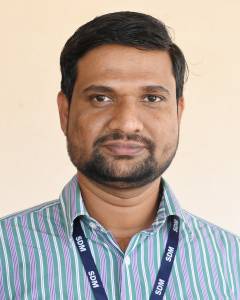
Mr. Dinesha

Mr. Dinesha

HOD

B.E

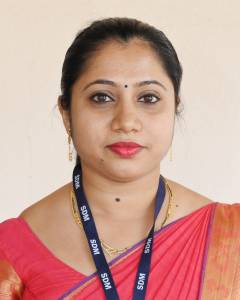
Ms. Renita V Fernandes

Ms. Renita V Fernandes

Lecturer

B.E

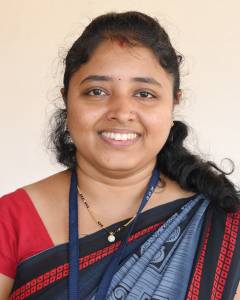
Ms. Prithvi V

Ms. Prithvi V

Lecturer

Diploma, B.E

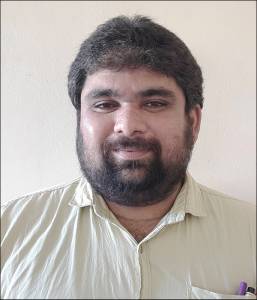
Mr. Varadaraj A S

Mr. Varadaraj A S

Lecturer

B.E

Ms. Anushree B K

Ms. Anushree B K

Lecturer

Diploma

Latest Post

News & Events

Guest Lecture on “Shift Registers and Its Applications in Computer Science”
A guest lecture on “Shift Registers and Its Applications in…
GUEST LECTURE FLIP-FLOPS & ITS APPLICATIONS
A guest lecture was conducted for the first-year Computer Science…
Internship and Job Opportunities by Codelab Systems
Codelab Systems conducted a technical talk on “Internship Opportunities” on…
Guest Lecture on Basics of Computers and Artificial Intelligence
The Department of Computer Science and Engineering, SDM Polytechnic, Ujire,…
Industrial Visit to SIRI, Belthangady
The Department of Computer Science of Shree Dharmasthala Manjunatheshwara Polytechnic,…